Water leakage can be a big problem in residential, commercial, and industrial buildings. Moisture penetration can corrode walls, concrete structures, and lead to higher repair costs.
Hence, it becomes essential to take measures and invest in waterproofing solutions that would prevent water seepage in a building.
HDPE Membrane Waterproofing is a contemporary solution that can be applied on foundations, underground surfaces, and basements to avoid leakage.
HDPE stands for High Density Polythene which is a thick and highly water-resistant polymer membrane.
In this article, we will look into HDPE membrane waterproofing, its benefits and uses, installation process, and cost in India.
What Is HDPE Membrane Waterproofing?
HDPE Membrane Waterproofing is a system where high-density polythene membranes are used to prevent water seepage in concrete surfaces. This waterproofing solution is mainly used for foundations, basement concrete floors, underground parking lots, and retaining wall structures.
HDPE waterproofing sheet is laid down and adhered to the concrete substrates to provide a thick water-resistant barrier.
These membranes are also available in specialized variants that can be adhered to the concrete on pouring.
Unlike liquid waterproofing, HDPE membranes are made in sheets of specific thickness and properties.
HDPE Waterproofing membranes work best when the joints are properly sealed and protected from abrasion.
How Does HDPE Waterproofing Work?
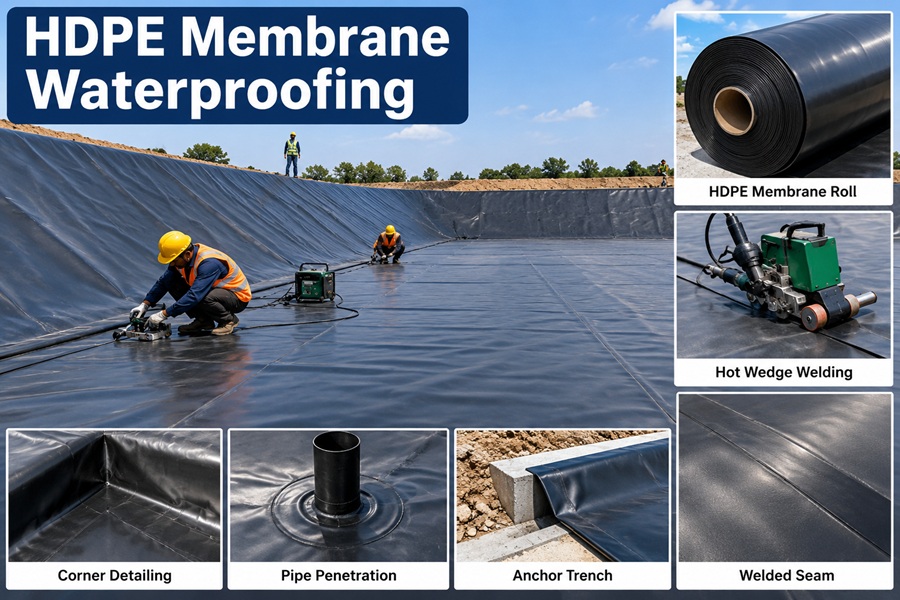
An HDPE waterproofing membrane works on a simple mechanism to prevent water seepage into concrete substrates. The flexible yet sturdy sheets are laid down on the target surface and sealed together with a special tape, welder, and other accessories.
HDPE waterproofing is also available in specialized variants that have bonding properties to prevent water from seeping through the gap between the membrane and the concrete.
It is to be noted that the corner joints, piping, and other such weak points need to be reinforced and sealed with special waterproofing accessories.
HDPE Waterproofing Membrane Benefits
HDPE waterproofing is a modern waterproofing solution that provides a host of benefits.
Let’s have a look at some of them.
1. Excellent Water-Resistance
One of the biggest advantages of HDPE Waterproofing is its incredible water resistance. Any water that attempts to seep through the membrane would be repelled due to the material’s natural water-repellent properties.
2. Extreme Durability
HDPE waterproofing membranes provide an excellent degree of durability and require minimal maintenance throughout their life cycle.
When installed properly and protected from abrasion, HDPE Waterproofing can provide long-term water-resistant protection for concrete substrates.
3. High Chemical Resistance
HDPE Waterproofing has strong resistance to various ground chemicals and is ideal for chemical-contaminated sites.
Nevertheless, it is always advisable to go through the manufacturer’s specifications to determine the level of chemical resistance.
4. Protection for Underground Surfaces
HDPE waterproofing membranes are extremely useful in protecting against water seepage in underground parking lots, substructures, and retaining walls.
5. Minimal Maintenance Requirements
With proper installation and protection from abrasion, HDPE waterproofing typically requires minimal maintenance and inspection.
HDPE Waterproofing system, once properly installed, does not require frequent maintenance checks.
However, it is vital to ensure that the HDPE Waterproofing membrane has been properly installed to avoid future leaks and the need for frequent maintenance.
With underground waterproofing, it becomes challenging to access the waterproofing system for inspection and maintenance.
6. Multiple Installation Variants
HDPE Waterproofing Membranes are available in multiple variants that can be utilized in diverse applications.
There are also specialized waterproofing membranes that have been manufactured for pre-application on concrete, and specialized waterproofing tapes and accessories that ensure a perfect application.
HDPE Waterproofing Applications
HDPE Waterproofing has a wide range of applications in the construction industry.
Some of the common applications of HDPE Waterproofing are as follows:
HDPE Waterproofing for Basement
Basement walls and slabs are exposed to ground moisture and require a reliable waterproofing solution to prevent leakage and dampness. HDPE Waterproofing is an ideal solution for waterproofing basement walls and slabs.
HDPE Waterproofing for Foundation
Foundations of structures are exposed to ground moisture and require reliable waterproofing to prevent leakage and potential damage to the structure. HDPE Waterproofing can be utilized to prevent water seepage into foundations.
HDPE Waterproofing for Parking
HDPE Waterproofing is ideally suited for underground parking lots and garages. The waterproofing membrane can be applied on the concrete slab and waterproofing the underground retaining walls.
HDPE Waterproofing for Tunnels
There are specialized high-density polythene waterproofing membranes that are designed for use in selected tunnel projects.
HDPE Waterproofing for Water Containment
HDPE geomembranes are widely used for water containment in ponds, basins, and other water bodies. HDPE geomembranes need to be selected based on the specific application, and they can differ from standard waterproofing membranes.
HDPE Waterproofing Installation Process
HDPE Waterproofing Installation requires professional expertise and experience to ensure that the waterproofing system is up to the standards and would provide long-term water-resistant protection. Here are the crucial steps involved in HDPE Waterproofing Installation:
1: Surface Preparation
Any HDPE Waterproofing project begins with surface preparation and ensuring that the substrates are leveled and free from sharp objects and roughness.
The concrete surface needs to be solid enough that it can support the waterproofing sheets without getting damaged.
2: Sheet Installation
The next step involves the actual HDPE Waterproofing sheet installation. HDPE Waterproofing sheets are placed as per the manufacturer’s specifications and recommendation. In the case of pre-applied sheets, the adhesive side needs to be placed against the concrete.
It is in this step that the joints of the waterproofing sheets are sealed using HDPE waterproofing special tape and accessories.
3: Corner & Pipe Installation
This step involves waterproofing accessories installation. HDPE Waterproofing comes with a variety of corner and pipe installations that are ideal for use in different applications.
Corners, piping, construction joints, and other such weak points in HDPE Waterproofing need to be reinforced with specialized corner and pipe waterproofing membranes.
4: Inspection
Once the HDPE Waterproofing sheet is laid down, it is time to inspect the waterproofing system for imperfections such as punctures, gaps, and wrinkles.
Defects in HDPE Waterproofing need to be fixed before the final step of concrete laying or protection.
5: Concrete Placement or Protection
The final step in HDPE Waterproofing installation involves concrete laying or concrete protection as per the requirement of HDPE Waterproofing. Any activity that can damage the waterproofing system should be avoided to ensure quality and long-term durability.
HDPE Waterproofing Cost India
The cost of HDPE Waterproofing in India can be highly variable depending on the membrane thickness, quality, and the overall requirement of the project. Below are some of the crucial factors that affect HDPE Waterproofing cost India:
Thickness of the Waterproofing Membrane
The thickness of HDPE Waterproofing determines the overall quality and longevity of the waterproofing system. Specialized high-density HDPE membranes would incur higher prices.
Project Size
Larger projects naturally entail higher expenditures, whereas smaller waterproofing projects might have lower expenditures for HDPE Waterproofing cost India.
Labour Cost
HDPE Waterproofing installation requires professional know-how and would require skilled workers to get the job done. HDPE Waterproofing costs India, can vary significantly based on labour cost.
Surface Condition
HDPE Waterproofing sheets need to be adhered to a flat surface. Uneven surfaces would require extra preparations before HDPE Waterproofing sheet installation.
Waterproofing Details
HDPE Waterproofing projects with a complex layout and design would require more materials for corner protection and piping. This would affect HDPE Waterproofing cost India.
Technology
HDPE Waterproofing technology can vary significantly from one manufacturer to the other. Fully bonded HDPE Waterproofing systems can be more expensive than standard HDPE Waterproofing systems.
For an accurate HDPE Waterproofing cost India quotation, it is advisable to request a quotation that would cover waterproofing materials cost, labour cost, HDPE Waterproofing joints, surface preparation, and protection.
HDPE Membrane Vs Bitumen Waterproofing
HDPE Membrane and Bitumen waterproofing are two of the most popular waterproofing solutions that are utilized in residential, commercial, and industrial constructions.
Here is a detailed comparison between HDPE Membrane and Bitumen Waterproofing:
| Feature | HDPE Membrane Waterproofing | Bitumen Waterproofing |
|---|---|---|
| Material | High density polythene | Asphalt-based material |
| Water-resistance | High water-resistance when correctly installed | High water-resistance when correctly installed |
| Installation | Specialized tapes, welder | Torch-on, self-adhesive, coating |
| Chemical-resistance | Good chemical-resistance | Chemical-resistance depends on formulation |
| Application | Foundations, underground surfaces | Foundations, Roofs, basements |
| Maintenance | Maintenance depends on installation and exposure | Maintenance depends on installation and exposure |
HDPE Waterproofing FAQs
1. What is HDPE waterproofing used for?
HDPE Waterproofing is primarily used for waterproofing foundations, underground surfaces, basement slabs, and retaining walls to prevent water seepage.
2. Is HDPE membrane 100% waterproof?
HDPE Waterproofing membrane is highly water-resistant but is not 100% waterproof. HDPE Waterproofing relies on sealing the edges and joints of the waterproofing sheets to prevent leakage.
3. How long does HDPE Waterproofing last?
The longevity of HDPE Waterproofing is dependent on the quality of Waterproofing membranes, surface exposure, installation, and other environmental factors. The HDPE Waterproofing lifetime can be determined from the warranty offered by the manufacturer.
4. Can HDPE Waterproofing be used for basement waterproofing?
Yes, HDPE Waterproofing can be used for basement waterproofing. HDPE Waterproofing sheets can be utilized for underground waterproofing of basement slabs and walls.
5. How much does HDPE Waterproofing cost?
HDPE Waterproofing cost can vary from one manufacturer to the other depending on the membrane thickness and technology utilized. It is advisable to request a quotation for an HDPE Waterproofing system that would encompass all expenses.
Conclusion
HDPE Waterproofing is a reliable waterproofing solution that can be utilized for foundation waterproofing, basement waterproofing, and underground waterproofing. HDPE Waterproofing provides long-term water-resistant protection for concrete substrates.
However, an HDPE Waterproofing system is only as good as its installation. It is vital to ensure that the HDPE Waterproofing sheets are properly sealed and protected from abrasion.
HDPE Waterproofing can be highly effective if the appropriate Waterproofing membrane and system are selected as per the specified application.
Always make sure that HDPE Waterproofing is installed by a professional and the manufacturer’s recommendation is followed for optimum results.